Businesses rarely struggle because they lack security tools. More often, they struggle because they don’t know where their real weaknesses are. That is exactly where vapt testing becomes valuable. Instead of relying on assumptions, vapt testing helps organizations uncover vulnerabilities, validate exploit paths, and understand how an attacker could move through their environment.
For growing companies, enterprises, SaaS providers, fintech firms, healthcare platforms, and compliance-driven teams, vapt testing is no longer a “nice to have.” It is a practical way to identify security gaps before they become incidents, customer-impacting outages, or regulatory problems. In this guide, we’ll break down what vapt testing means, how it works, what it covers, and how to choose the right provider for your business.
What Is VAPT Testing?
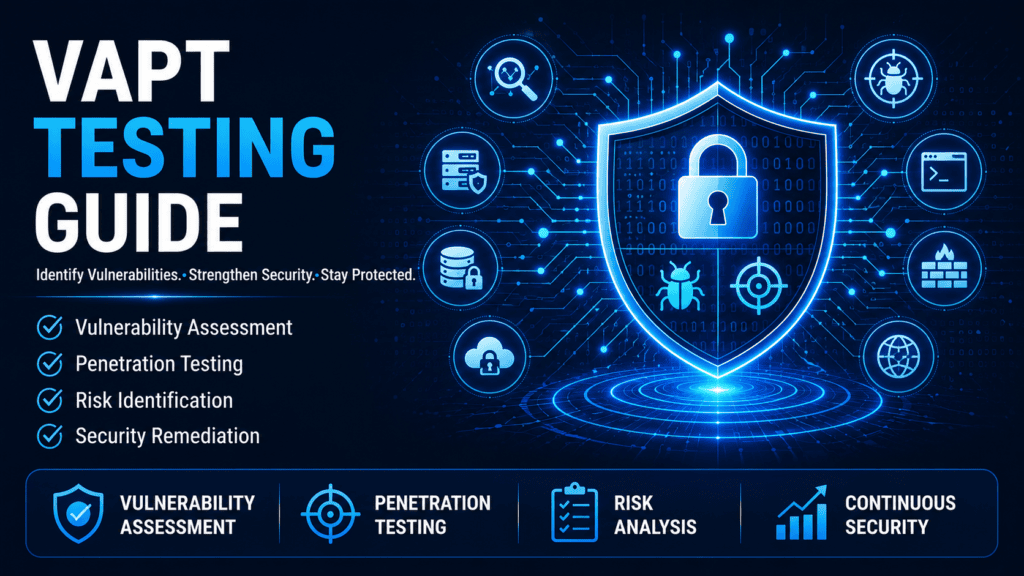
VAPT testing stands for Vulnerability Assessment and Penetration Testing. It combines two complementary security activities:
- Vulnerability Assessment (VA): A systematic process of identifying, classifying, and prioritizing security weaknesses in systems, applications, networks, APIs, and cloud environments.
- Penetration Testing (PT): A controlled attempt to exploit those weaknesses the way a real attacker might, to understand business impact and confirm risk.
In simple terms, vapt testing tells you two things:
- What is vulnerable in your environment
- What can actually be exploited and how serious the impact could be
That distinction matters. A vulnerability scan may flag dozens of issues, but not all of them are exploitable in a meaningful way. A mature vapt testing engagement helps separate noise from actual business risk.
Why VAPT Testing Matters for Businesses
Security teams are under pressure to move fast, support digital growth, and stay compliant. Meanwhile, the attack surface keeps expanding across web apps, mobile apps, cloud workloads, third-party integrations, remote users, and APIs. Vapt testing helps organizations keep up with that reality.
Here’s why businesses invest in vapt testing:
1. It reveals real-world attack paths
A list of CVEs is useful, but leadership needs context. Vapt testing shows how a vulnerability could be chained with weak authentication, exposed services, or poor privilege controls to create a larger compromise.
2. It helps prioritize remediation
Not every finding deserves the same urgency. Vapt testing highlights which issues create the highest risk so teams can focus on fixes that materially reduce exposure.
3. It supports compliance and customer trust
Many organizations need vulnerability assessment and penetration testing to support requirements under standards, contracts, or customer due diligence. Even when it isn’t explicitly mandated, it strengthens audit readiness and demonstrates security maturity.
4. It reduces the cost of incidents
Fixing a flaw before it is exploited is far cheaper than handling ransomware, data loss, service disruption, legal exposure, or reputational damage after the fact.
Vulnerability Assessment vs Penetration Testing: What’s the Difference?
A lot of buyers use the terms interchangeably, but they are not the same.
Vulnerability Assessment
A vulnerability assessment is broad and discovery-focused. It aims to identify known weaknesses across systems, applications, and infrastructure. This may include:
- Missing patches
- Misconfigurations
- Weak encryption settings
- Exposed services
- Outdated software versions
- Insecure default settings
The output is usually a prioritized list of findings with severity ratings and remediation recommendations.
Penetration Testing
Penetration testing goes a step further. Instead of only listing vulnerabilities, the tester actively attempts to exploit them in a controlled and authorized way. This helps validate:
- Whether a weakness is truly exploitable
- What access an attacker could gain
- How far lateral movement could go
- What data or systems may be at risk
A strong vapt testing engagement uses both. The assessment provides breadth; the penetration test provides depth and business context.
Types of VAPT Testing
Not every organization needs the same scope. The right vapt testing plan depends on your infrastructure, application stack, risk profile, and compliance obligations. Common engagement types include:
Web Application VAPT Testing
This focuses on websites, portals, SaaS platforms, and customer-facing applications. Web application security testing commonly looks for issues such as:
- SQL injection
- Cross-site scripting (XSS)
- Broken authentication
- Insecure session handling
- Access control flaws
- Business logic abuse
- Sensitive data exposure
- Insecure file upload or API calls
If your business relies on a login portal, e-commerce platform, admin dashboard, or web-based customer workflow, web-focused vapt testing should be a regular part of your security program.
Network VAPT Testing
This tests internal and external network infrastructure, including firewalls, servers, VPNs, endpoints, exposed ports, wireless networks, and segmentation controls. A network security assessment can uncover:
- Open or unnecessary services
- Weak remote access controls
- Legacy protocols
- Misconfigured firewall rules
- Lateral movement opportunities
- Poor network segmentation
API VAPT Testing
APIs often expose sensitive business functions and customer data. API-focused vapt testing checks for broken object-level authorization, token misuse, rate-limiting issues, insecure endpoints, excessive data exposure, and flawed authentication flows.
Cloud VAPT Testing
Cloud environments introduce configuration risks that traditional on-prem security testing may miss. Cloud vapt testing often evaluates IAM permissions, public storage exposure, security group misconfigurations, insecure containers, logging gaps, and overly permissive roles.
Mobile Application VAPT Testing
Mobile apps can expose sensitive data through weak storage, poor certificate validation, insecure APIs, reverse engineering risks, and hardcoded secrets. Mobile-focused application security testing is especially important for fintech, healthcare, and consumer apps.
What Vulnerabilities Can VAPT Testing Uncover?
A well-run vapt testing engagement can uncover both common and high-impact issues across multiple layers of your environment. Examples include:
- Injection vulnerabilities
- Broken access controls
- Weak passwords and poor MFA enforcement
- Exposed admin interfaces
- Misconfigured cloud resources
- Unpatched software and libraries
- Insecure API authentication
- Sensitive data exposure
- Server misconfigurations
- Privilege escalation opportunities
- Session management weaknesses
- Insufficient logging and monitoring
- Security header issues
- Third-party component vulnerabilities
The real value of vapt testing is not only finding the weakness, but explaining how it affects business operations, customer data, uptime, and compliance risk.
How the VAPT Testing Process Works
The best vapt testing engagements are structured, transparent, and tied to business outcomes. While methodologies vary slightly between providers, the process usually includes the following stages.
1. Scoping and asset understanding
The engagement starts with identifying what is being tested: applications, IP ranges, APIs, cloud workloads, user roles, or business-critical workflows. Good scoping matters because incomplete scope creates blind spots, while overly broad scope can waste budget.
2. Reconnaissance and discovery
The testing team maps the attack surface and gathers information about hosts, technologies, services, and possible entry points. This helps shape the rest of the vapt testing effort.
3. Vulnerability identification
This stage combines manual analysis with tooling to identify security weaknesses. In mature cybersecurity testing services, automation supports speed, but manual validation is what separates meaningful findings from scanner noise.
4. Exploitation and validation
In the penetration testing phase, testers attempt to exploit selected vulnerabilities in a controlled way. The goal is not disruption; it is evidence-based validation of risk.
5. Risk analysis and reporting
A good vapt audit report should clearly explain:
- What was found
- How it was validated
- Business impact
- Severity and likelihood
- Affected assets
- Proof of concept where appropriate
- Remediation guidance
- Executive summary for leadership
6. Remediation support and retesting
The most useful vapt testing engagements do not end with a PDF. They include remediation guidance, technical clarification for engineering teams, and retesting to confirm fixes are effective.
How Often Should You Perform VAPT Testing?
There is no single schedule that fits every organization, but vapt testing should not be treated as a one-time exercise. As a practical baseline, businesses should consider testing:
- At least annually for core systems and critical applications
- Before launching a new application, major feature, or public-facing platform
- After major infrastructure or cloud architecture changes
- After mergers, acquisitions, or major third-party integrations
- Following a serious incident or suspected compromise
- More frequently for regulated, high-growth, or high-risk environments
If you release often, handle payment data, store sensitive personal information, or operate in a heavily targeted industry, more frequent penetration testing services are usually justified.
Which Industries Need VAPT Testing the Most?
Almost any organization with internet-facing systems benefits from vapt testing, but some sectors have a stronger need due to data sensitivity, uptime requirements, or compliance pressure.
Financial services and fintech
These organizations face constant attacks targeting payments, customer accounts, fraud controls, and APIs.
Healthcare and healthtech
Patient data, connected systems, and strict privacy obligations make security vulnerability testing essential.
SaaS and technology companies
Fast release cycles and complex integrations can introduce security gaps quickly, especially in APIs and cloud environments.
E-commerce and retail
Payment workflows, customer data, admin panels, and third-party plugins increase risk exposure.
Manufacturing and critical infrastructure
Hybrid IT/OT environments can create blind spots that standard security checks miss.
Government contractors and enterprise service providers
Vendor security reviews increasingly expect evidence of vapt services, risk management, and secure development practices.
VAPT Testing vs Regular Security Audits
A security audit and vapt testing serve different purposes. A security audit typically reviews policies, controls, documentation, and configuration posture against a framework or internal standard. It answers: Are the right controls present?
Vapt testing answers a different question: Can those weaknesses be exploited, and what happens if they are?
Both matter. Audits help with governance and compliance. Vapt testing provides technical validation and attacker-focused insight. For many businesses, the strongest approach is to use both rather than choosing one over the other.
What a Good VAPT Report Should Include
If you are paying for vapt testing, the report quality matters as much as the testing itself. A strong report should include:
- Executive summary for leadership
- Scope and methodology
- Asset inventory or tested components
- Detailed findings with severity
- Evidence of exploitation or validation
- Business impact explanation
- Remediation guidance with practical steps
- Prioritized action plan
- Retest results if remediation has already started
The report should be understandable to both technical teams and business stakeholders. If a report is full of screenshots but light on business impact or remediation clarity, it is not doing enough.
Common Mistakes Businesses Make with VAPT Testing
Even companies that invest in vapt testing sometimes reduce its value through avoidable mistakes.
Treating it as a compliance checkbox
If the goal is only to “get a report,” teams often miss the real benefit: reducing exploitable risk.
Testing too narrowly
Only testing one app while ignoring APIs, cloud configuration, admin interfaces, or internal privilege paths creates false confidence.
Skipping remediation planning
A finding without an owner, timeline, and retest plan is just documentation. The return on vapt testing comes from fixing what matters.
Choosing a provider based only on price
The cheapest engagement may rely heavily on automated scanning and produce shallow results. Strong vulnerability assessment and penetration testing requires skilled human validation.
Not retesting after fixes
Without retesting, teams may assume a vulnerability is resolved when the root cause still exists.
How to Choose the Right VAPT Testing Company
If you’re evaluating providers, ask practical questions beyond “What’s the price?”
Look for a team that can explain:
- How they scope engagements
- How much of the testing is manual vs automated
- Whether they test business logic and real exploit paths
- What their reporting looks like
- Whether they offer remediation guidance and retesting
- What experience they have with your tech stack and industry
- How they handle confidentiality and testing safety
A good vapt testing partner should feel like an extension of your security team, not just a vendor sending a list of scanner outputs.
FAQ: VAPT Testing
What is VAPT testing?
Vapt testing is the combination of vulnerability assessment and penetration testing used to identify, validate, and prioritize security weaknesses in applications, networks, APIs, cloud environments, and other systems.
What is the difference between VA and PT?
Vulnerability assessment focuses on finding and classifying weaknesses. Penetration testing attempts to exploit those weaknesses to confirm real-world risk and business impact.
How much does VAPT testing cost?
The cost depends on scope, complexity, asset count, testing depth, and whether you need web, network, API, cloud, or mobile testing. A public-facing SaaS platform will require a different level of effort than a small brochure website or limited network segment.
How often should VAPT testing be done?
At minimum, organizations should consider annual vapt testing for critical systems, with additional testing after major releases, infrastructure changes, cloud migrations, or security incidents.
Is VAPT testing required for compliance?
It depends on the regulation, client contract, and industry standard involved. Even when not strictly mandated, vapt testing is often expected during audits, vendor reviews, and security due diligence processes.
Conclusion
The most useful vapt testing engagements do more than identify vulnerabilities. They show how risk appears in your real environment, which weaknesses deserve immediate attention, and how your team can improve security without slowing down the business. For companies building customer-facing applications, managing cloud infrastructure, or operating under compliance pressure, vapt testing is one of the clearest ways to turn security from assumption into evidence.
If your organization is planning a new product launch, preparing for an audit, responding to customer security questionnaires, or simply trying to understand where your exposure really sits, this is the right time to evaluate your current testing approach.
Work With Cyber Guardians
At Cyber Guardians, we help businesses turn security testing into practical risk reduction. Our vapt testing approach is built for modern environments, including web applications, APIs, cloud infrastructure, internal networks, and mobile platforms. If you want a clear view of your exploitable risk—not just a list of scan results—our team can help you scope the right assessment, validate real threats, and prioritize remediation that matters. Book a consultation, request a VAPT assessment, or speak with a cybersecurity expert at Cyber Guardians to get a custom security evaluation tailored to your environment.