Introduction
Today’s customers not only want excellent products and services; they also want their personal information to be kept safe and secure. As cyber threats are getting more sophisticated and governments are tightening their regulations, companies have to show that they have proper security measures in place. This is where SOC 2 Compliance plays a critical role.
SOC 2 Compliance helps demonstrate that your organization has implemented effective controls to protect customer data, ensure system availability, maintain confidentiality, and manage information securely.
Many enterprise customers require a SOC 2 report before approving a new vendor. Having one can shorten sales cycles, build customer trust, and create new business opportunities.
In this guide, you’ll learn what SOC 2 Compliance is, who needs it, the Trust Services Criteria, the audit process, implementation steps, common challenges, best practices, and how to prepare for a successful SOC 2 audit.
Table of Contents
1. What is SOC 2 Compliance?
2. Why SOC 2 Compliance Matters
3. Who Needs SOC 2 Compliance?
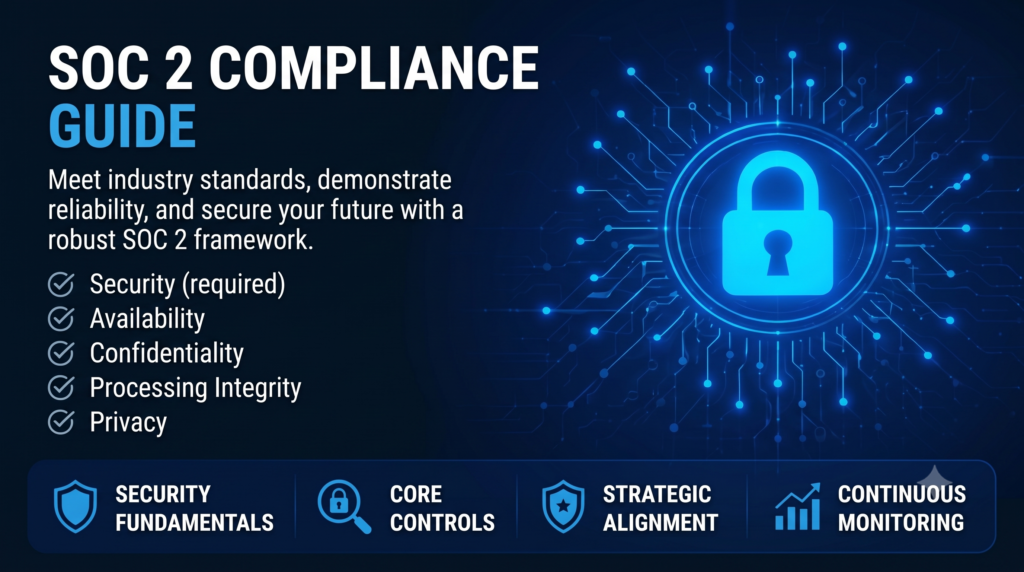
4. Understanding the Five Trust Services Criteria
5. SOC 2 Type 1 vs Type 2
6. SOC 2 Audit Process
7. Timeline and Cost
8. Common Challenges
9. Best Practices
10. Benefits of SOC 2 Compliance
11. How Cyber Guardians Can Help
12. FAQs
13. Conclusion
What is SOC 2 Compliance?
SOC 2 Compliance is a globally recognized standard that allows businesses to demonstrate that they have implemented adequate safeguards for their customer data.
Developed by the American Institute of Certified Public Accountants (AICPA), it evaluates whether an organization’s controls effectively protect customer data based on the Trust Services Criteria: Security, Availability, Processing Integrity, Confidentiality, and Privacy.
Unlike industry-specific regulations, SOC 2 Compliance is designed for organizations that store, process, or transmit customer data in cloud-based environments.
A SOC 2 audit evaluates whether an organization has designed and implemented controls that meet its selected Trust Services Criteria. Auditors also assess governance, security policies, employee practices, risk management, and operational processes—not just technical controls.
Why SOC 2 Compliance Matters
Data breaches cause a lot of harm to an organization’s image. They also result in financial losses and reduce the level of trust customers have in the affected company.
Here are the key business benefits of achieving SOC 2 Compliance:
1. Builds Customer Trust
Many enterprise organizations require vendors to demonstrate their security practices before sharing sensitive data.
A SOC 2 report provides independent assurance that your organization’s security controls have been evaluated by a licensed CPA firm.
2. Supports Business Growth
Many organizations have their teams who are responsible for making purchasing decisions and one of their key criteria for selecting a vendor is whether this vendor has had a SOC 2 audit or not.
A SOC 2 report can shorten sales cycles and help organizations qualify for larger enterprise opportunities.
3. Strengthens Information Security
Preparing for a SOC 2 audit encourages organizations to strengthen security controls, formalize policies, improve monitoring, and enhance risk management.
4. Limits Business Risk
SOC 2 encourages organizations to identify and address security weaknesses before they become incidents.
Risk assessment done regularly, together with incident response planning and continuous monitoring give an enterprise a notable edge in cybersecurity.
5. Shows That One is Responsible
Customers, partners, and investors want assurance that your organization takes information security seriously. A SOC 2 report demonstrates your commitment to security through independently audited controls.
Who Needs SOC 2 Compliance?
SOC 2 Compliance is most beneficial for organizations that store, process, transmit, or manage customer data.
Organizations that commonly pursue SOC 2 include:
• SaaS companies
• Cloud service providers
• Managed Service Providers (MSPs)
• Data analytics firms
• Financial technology companies
• Artificial Intelligence platforms
• Healthcare technology providers
• Customer support platforms
• IT consulting firms
If your organization handles sensitive customer information or provides cloud-based services, SOC 2 Compliance can help demonstrate your commitment to security and meet customer expectations.
Understanding the Five Trust Services Criteria
The Trust Services Criteria (TSC) form the foundation of SOC 2 Compliance. They define the areas an auditor evaluates when assessing an organization’s controls.
Security is a must-have element in every SOC 2 engagement. The remaining criteria are selected based on your organization’s services and customer requirements.
1. Security
Firms need to build up security measures that defend systems and data from unauthorized access, cyber threats, and other misuses of security loopholes.
Examples include:
• Multi-factor authentication
• Role-based access controls
• Endpoint protection
• Network security
• Vulnerability management
• Incident response planning
2. Availability
Availability is a focus on making sure that systems continue to work and be ready for use as per the arrangements with customers.
Organizations should establish processes for:
• Infrastructure monitoring
• Disaster recovery planning
• Business continuity procedures
• Backup and restoration testing
• Capacity planning
The goal is to reduce the time during which services are not available while at the same time maintaining reliable service delivery.
3. Processing Integrity
Processing Integrity evaluates whether systems process information accurately, completely, and in a timely manner.
Controls may include:
• Data validation
• Change management controls
• Error detection
• Quality assurance procedures
• Transaction monitoring
Such steps are instrumental in helping organizations to continuously build their trust in the dependability of their systems and the outputs they generate.
4. Confidentiality
Confidentiality is about keeping sensitive business information safe from being disclosed to anyone outside the authorized person.
Confidentiality is the protection of assets that are secret like intellectual property, financial records, customer contracts and other proprietary business data.
Companies that want SOC 2 Compliance need to put in place measures like:
• Encryption for data at rest and in transit
• Role-based access control (RBAC)
• Secure file-sharing processes
• Non-disclosure agreements (NDAs)
• Secure disposal of sensitive data
• Data Loss Prevention (DLP) solutions
These measures help ensure confidential information is accessible only to authorized individuals.
5. Privacy
Privacy is a concern for any organization that collects stores processes, or shares personal information. It looks at how personal data is handled in line with documented privacy promises and the relevant laws.
Typical privacy controls include:
• Consent management
• Privacy notices
• Data retention policies
• Data deletion procedures
• Customer data access requests
• Secure processing of personal information
• Employee privacy training
Strong privacy controls help organizations comply with data protection regulations and meet customer expectations.
| Criteria | Purpose |
|---|---|
| Security | Protect systems and data |
| Availability | Keep systems operational |
| Processing Integrity | Ensure accurate processing |
| Confidentiality | Protect sensitive information |
| Privacy | Manage personal information responsibly |
SOC 2 Type 1 vs SOC 2 Type 2: Key Differences
One of the most common questions organizations ask is whether they need SOC 2 Type 1 or SOC 2 Type 2. While both reports assess security controls, they differ in scope and duration.
| Feature | SOC 2 Type 1 | SOC 2 Type 2 |
|---|---|---|
| Assessment Focus | Design of controls | Design and operating effectiveness of controls |
| Time Period | Single point in time | Observation period (typically 3–12 months) |
| Best For | Organizations starting their compliance journey | Organizations demonstrating long-term operational effectiveness |
| Assurance Level | Initial assurance | Higher assurance over time |
| Enterprise Preference | Sometimes accepted | Often preferred by enterprise customers |
SOC 2 Type 1
A SOC 2 Type 1 report evaluates whether your organization’s security controls are appropriately designed on a specific date.
It is often the first step for businesses building a formal compliance program.
SOC 2 Type 2
A SOC 2 Type 2 report goes further by evaluating whether those controls operate effectively over a defined period.
Because it demonstrates that controls operate consistently over time, many enterprise customers prefer SOC 2 Type 2 reports.
Which One Should You Choose?
Choose SOC 2 Type 1 if you’re implementing controls for the first time or need an initial assessment.
Choose SOC 2 Type 2 if you want to provide stronger assurance to customers and meet more demanding vendor security requirements.
SOC 2 Audit Process: Step-by-Step Guide
Achieving SOC 2 Compliance requires a structured approach. Most organizations follow several key phases, from defining scope and implementing controls to completing the audit and maintaining compliance.
Step 1: Define the Scope
Identify:
• Systems in scope
• Applications
• Infrastructure
• Business processes
• Customer data
• Applicable Trust Services Criteria
A clearly defined scope reduces unnecessary complexity and keeps the project focused.
Step 2: Conduct a Gap Assessment
A gap assessment helps identify weaknesses before the official SOC 2 audit begins.
A gap assessment identifies:
• Missing policies
• Weak security controls
• Documentation gaps
• Technical vulnerabilities
• Process inconsistencies
• Compliance risks
Meeting these challenges will go a long way to gearing you up for the audit.
Step 3: Implement Required Controls
Organizations typically strengthen their environment by implementing:
• Multi-factor authentication
• Access management
• Endpoint protection
• Security awareness training
• Vulnerability management
• Logging and monitoring
• Backup and recovery procedures
• Incident response plans
• Vendor risk management
• Change management processes
These controls should align with your organization’s size, risk profile, and business operations.
Step 4: Prepare Documentation
Documentation plays a central role in demonstrating compliance.
SOC 2 auditors require documented evidence showing that security policies and procedures are defined and consistently followed.
Common documents include:
• Identity and Access Controls
• Multi-factor authentication
• Access management
• Role-based permissions
• Security Operations
• Endpoint protection
• Vulnerability management
• Logging and monitoring
• Business Continuity
• Backup procedures
• Disaster recovery
• Incident response
• Governance
• Vendor management
• Change management
Well-maintained documentation provides evidence that security practices are formally established and consistently followed.
Step 5: Collect Evidence
Evidence proves that implemented controls are working as intended.
Examples include:
• Access review reports
• Vulnerability scan results
• Employee training records
• Backup logs
• Change management approvals
• Security monitoring reports
• Incident response testing
Maintaining evidence throughout the year makes the audit process significantly smoother.
Step 6: Complete the SOC 2 Audit
A licensed CPA firm reviews your controls, interviews personnel, examines evidence, and evaluates whether your organization meets the selected Trust Services Criteria.
For a Type 2 report, auditors also verify that controls operated effectively over the review period.
Step 7: Maintain Continuous Compliance
SOC 2 is not a one-time achievement.
Organizations should continuously:
• Review risks
• Update policies
• Monitor security events
• Conduct internal audits
• Train employees
• Improve controls
Continuous compliance strengthens security and simplifies future audits.
How Long Does SOC 2 Compliance Take and How Much Does It Cost?
One of the most common questions organizations ask is, “How long does SOC 2 Compliance take?” The answer depends on your organization’s current security maturity, the complexity of your environment, and whether you’re pursuing a SOC 2 Type 1 or SOC 2 Type 2 report.
For organizations with well-established security practices, preparing for a Type 1 audit may take a few months. If you’re pursuing a Type 2 report, you’ll also need an observation period during which your controls operate consistently before the audit is completed.
Factors That Affect SOC 2 Timeline
Several factors influence the timeline, including:
• Existing security controls and policies
• Size of the organization
• Number of employees and systems in scope
• Cloud infrastructure complexity
• Availability of documentation
• Speed of addressing identified gaps
• Readiness of internal teams
Organizations that begin with a thorough gap assessment and a structured implementation plan often move through the process more efficiently.
How Much Does SOC 2 Compliance Cost?
Rather than having a fixed price, the cost of SOC 2 Compliance varies depending on your organization’s needs.
The total cost depends on several factors, including:
• Size of the business
• Number of employees
• Scope of systems and applications
• Current security maturity
• Existing documentation
• Whether you’re pursuing Type 1 or Type 2
• Internal resources available
• Need for external consulting or compliance automation tools
• Audit fees charged by the CPA firm
Common SOC 2 Compliance Challenges and How to Overcome Them
Organizations often face similar challenges while preparing for SOC 2 Compliance. Identifying these issues early can help teams avoid delays and improve audit readiness.
1. Incomplete Documentation
Missing or outdated policies, procedures, and records are common audit obstacles. SOC 2 auditors require evidence that controls are documented and consistently followed.
2. Unclear Ownership
Without clearly assigned responsibilities, security tasks may be overlooked. Assigning control owners helps ensure accountability.
3. Access Management Issues
During SOC 2 readiness assessments, organizations often discover inactive accounts, excessive permissions, and weak access review processes.
4. Limited Security Awareness
Technology alone is not enough. Employees play a vital role in maintaining a secure environment, making regular security awareness training essential.
5. Vendor Risk Management
Third-party vendors can introduce additional risks. A structured process for evaluating and monitoring vendors is an important component of a mature security program.
6. Continuous Monitoring
SOC 2 is not a one-time project. Maintaining compliance requires ongoing monitoring, regular reviews, and continual improvement of controls.
7. Lack of Evidence Collection
Many organizations implement security controls but fail to maintain sufficient evidence. Keeping audit logs, access reviews, training records, and security reports organized throughout the year makes the SOC 2 audit process smoother.
SOC 2 Compliance Best Practices for Successful Audit Preparation
A successful SOC 2 program requires continuous effort rather than last-minute preparation. The following best practices help organizations build stronger security controls and maintain audit readiness.
1. Start with a Gap Assessment
A SOC 2 gap assessment identifies security weaknesses, documentation gaps, and missing controls before the audit begins.
2. Build Security into Daily Operations
Security controls should become part of routine business processes rather than existing solely for audit purposes.
3. Maintain Comprehensive Documentation
Keep policies, procedures, and evidence current. Organized documentation simplifies audits and demonstrates operational maturity.
4. Conduct Regular Risk Assessments
Business environments change over time. Regular risk assessments help identify emerging threats and ensure controls remain effective.
5. Automate Where Appropriate
Compliance automation tools can streamline evidence collection, policy management, and continuous monitoring, reducing manual effort.
6. Train Employees Regularly
Security awareness training reinforces best practices and helps employees recognize phishing attempts, social engineering, and other common threats.
7. Assign Control Owners
Assign ownership for each SOC 2 control to ensure accountability. Clearly defined responsibilities help prevent missed tasks and improve compliance consistency.
8. Perform Internal Reviews
Regular internal reviews and SOC 2 readiness assessments help organizations identify and resolve issues before the formal audit.
Common SOC 2 Compliance Mistakes to Avoid During Audit Preparation
Many organizations struggle with SOC 2 preparation because they treat compliance as a one-time project instead of an ongoing security program. Avoiding these common mistakes can make the audit process smoother and more successful.
Organizations can improve their chances of a successful audit by avoiding these common mistakes:
• Waiting until the audit is scheduled before starting preparation.
• Treating compliance as a one-time project instead of an ongoing program.
• Ignoring documentation requirements.
• Overlooking third-party vendor risks.
• Failing to perform regular access reviews.
• Neglecting employee security training.
• Implementing controls without testing their effectiveness.
• Delaying remediation of identified gaps.
• Assuming technical controls alone are sufficient without supporting policies and governance.
• Failing to organize audit evidence throughout the year can create unnecessary delays during the SOC 2 audit. Organizations should maintain records of access reviews, security monitoring, training, and control activities regularly.
Key Benefits of SOC 2 Compliance for Businesses
SOC 2 Compliance provides benefits beyond passing an audit. It helps organizations improve security, build customer confidence, and create stronger business processes.
1. Strengthens Customer Confidence
An independent SOC 2 assessment shows customers that your organization has implemented and maintained effective security controls.
2. Accelerates Sales Cycles
Many enterprise procurement teams request a SOC 2 report during vendor evaluations. Having one readily available can reduce delays and simplify security reviews.
3. Improves Internal Processes
Implementing structured policies and controls often leads to more consistent operations, clearer responsibilities, and better governance.
4. Enhances Risk Management
The process encourages organizations to identify, assess, and address risks proactively, reducing the likelihood of security incidents.
5. Supports Business Growth
For SaaS providers and technology companies, SOC 2 Compliance can become a competitive differentiator when pursuing larger customers or expanding into new markets.
6. Creates a Security-Focused Culture
SOC 2 encourages organizations to establish security responsibilities across teams. Regular training, documented processes, and continuous monitoring help create a stronger security culture.
How Cyber Guardians Helps Organizations Prepare for SOC 2 Compliance
Preparing for SOC 2 Compliance can be challenging, especially for growing organizations managing security requirements alongside daily business operations.
Cyber Guardians helps organizations build practical, risk-based SOC 2 programs by identifying gaps, implementing controls, and preparing teams for successful audits.
Our services include:
• Readiness and Assessment
• Gap Analysis
• Risk Assessments
• Policy and Control Implementation
• Security Policy Development
• Control Implementation Guidance
• Audit Preparation
• Evidence Collection Support
• Internal Audit Preparation
• Audit Coordination
• Continuous Compliance Support
• Monitoring
• Advisory
Our approach is tailored to your business model, technology environment, and customer requirements, helping you create a SOC 2 program that supports long-term security and growth.
Our SOC 2 specialists help organizations move from initial readiness assessment to audit preparation by providing structured guidance throughout the compliance lifecycle.
FAQs About SOC 2 Compliance
1. What is SOC 2 Compliance?
SOC 2 Compliance is an auditing framework developed by the AICPA that evaluates whether organizations have effective controls for protecting customer data across Security, Availability, Processing Integrity, Confidentiality, and Privacy.
2. Is SOC 2 Compliance mandatory?
No, SOC 2 Compliance is not legally mandatory. However, many enterprise organizations require vendors to provide a SOC 2 report before approving business relationships.
3. What is the difference between SOC 2 Type 1 and Type 2?
SOC 2 Type 1 evaluates whether controls are properly designed at a specific point in time, while SOC 2 Type 2 evaluates whether those controls operate effectively over a defined period.
4. How long does SOC 2 Compliance take?
Most organizations complete SOC 2 preparation within 3–12 months, depending on their existing security maturity, system complexity, audit scope, and the type of report required.
5. How much does SOC 2 Compliance cost?
SOC 2 costs vary based on organization size, audit scope, security maturity, consulting requirements, compliance tools, and CPA audit fees.
6. Who needs SOC 2 Compliance?
SOC 2 is commonly pursued by SaaS companies, cloud service providers, fintech organizations, healthcare technology companies, MSPs, and businesses that handle sensitive customer data.
7. What are the SOC 2 Trust Services Criteria?
The SOC 2 Trust Services Criteria include Security, Availability, Processing Integrity, Confidentiality, and Privacy. These criteria define the areas auditors evaluate when reviewing an organization’s controls.
8. What documents are required for SOC 2 Compliance?
Common SOC 2 documentation includes security policies, access control procedures, risk assessments, incident response plans, business continuity plans, vendor management policies, and evidence of control activities.
Conclusion
In today’s digital environment, trust and security are critical business advantages. SOC 2 Compliance helps organizations demonstrate that they have effective controls in place to protect customer data, manage risks, and maintain reliable operations. Although achieving SOC 2 requires planning and ongoing effort, it can improve security maturity, simplify customer reviews, and support business growth.
Cyber Guardians helps organizations assess their security posture, identify compliance gaps, implement effective controls, and prepare for successful SOC 2 audits.
Ready to prepare for SOC 2 Compliance? Contact Cyber Guardians for a SOC 2 readiness assessment and identify the steps needed to achieve audit readiness.