Healthcare organizations generally have access to some of the most sensitive information across industries. Patient records usually include personal and private details such as names, dates of birth, insurance numbers, treatment histories, billing data, and other unique identifiers, all of which can be very attractive to cybercriminals. This vulnerability explains why the healthcare sector is often targeted for phishing campaigns, ransomware attacks, credential theft, insider breaches, and misuse of third-party vendors.
At this point, HIPAA is more than just a legal acronym. For healthcare providers, billing companies, digital health pioneers, and all businesses dealing with protected health information, HIPAA works as a practical tool for enhancing patient data security, minimizing breaches, and fostering trust. It’s more than a compliance tick-mark left to the legal department only; it influences the way access is managed, endpoints are secured, data is encrypted, employees are trained, vendors are evaluated, and incidents are handled.
Cybersecurity-wise, HIPAA significance is that it ties privacy duties to tangible operational security measures. In case your organization retains or processes patient data, being HIPAA-compliant is a powerful step towards strengthening your security and steering clear of compliance mishaps.
What Is HIPAA?
HIPAA is an acronym for Health Insurance Portability and Accountability Act. It is a U.S. legislation that was first ratified in 1996 to facilitate the portability of health insurance and to set the rules for the security of healthcare information. With the passage of time, HIPAA has become one of the main regulatory pillars for healthcare privacy and data security.
Fundamentally, HIPAA intends to secure the privacy of protected health information (PHI), which is a patient’s identifiable healthcare data. The healthcare information can be linked to a person’s physical or mental health condition, the provision of healthcare, or related payment. The regulation affects any entity involved in the creation receipt storage, or transmission of such information in the prespecified contexts.
Who needs to comply with HIPAA?
HIPAA generally applies to two main groups:
1. Covered Entities
These include:
- Healthcare providers such as hospitals, clinics, physicians, dentists, and therapists
- Health plans and health insurers
- Healthcare clearinghouses
2. Business Associates
These are third parties handling PHI representing a covered entity, for example:
- Medical billing companies
- Cloud hosting suppliers working with healthcare clients
- Managed IT and cybersecurity service providers with access to PHI
- EHR support providers
- Claims processing vendors
- Data storage or backup partners
Since HIPAA compliance for covered entities and business associates is not only about having the right policies, it also involves ensuring the presence of administrative, technical, and physical security measures that safeguard patient information in the actual systems and workflows.
Why HIPAA Matters in Cybersecurity
Many healthcare organizations still associate HIPAA Mostly with privacy notices and paperwork. Still, HIPAA cybersecurity is an essential component of healthcare today.
Healthcare data is valuable for multiple reasons. While a credit card thief usually gets canceled in a short time, a patient’s medical record, identity details, and insurance information are almost impossible to replace. In addition, attackers can carry out various types of fraud, like identity theft extortion insurance abuse, and social engineering by using healthcare data. This is why healthcare continues to be a high-risk sector for cybercrime.
Common cybersecurity threats that create HIPAA risk
Phishing and credential theft
One phishing email might be enough to reveal login information of email accounts, EHR systems, file shares, or billing platforms. After that, attackers can use the access to roam around the network, steal data, or launch a ransomware attack.
Ransomware
Ransomware can bring the paralysis of essential healthcare systems, putting patient care on hold, causing havoc in scheduling and billing, and leading to data breach scenarios if the data is accessed or stolen. Even if the functioning of the hospital is resumed the incident may result in the triggering of serious HIPAA compliance obligations.
Insider threats
Human errors or insider threat are also common causes of data breaches. Sometimes it is colleagues, partners, or third-party users who accessed the patient data without authority, either deliberately or accidentally.
Weak access controls
Shared accounts, giving users more privileges than necessary, not using multi-factor authentication and having poor password hygiene are some of the causes which will lead to unauthorized access to PHI.
Third-party vendor exposure
Healthcare providers usually rely on software companies, cloud service providers, billing partners and IT support companies. If these third parties are given the task of handling PHI, their security issues could be your HIPAA concern too.
For this reason, healthcare cybersecurity compliance should not be limited to policies in writing alone. Entities should consider HIPAA as one of the security disciplines to be practiced daily by operations.
Key HIPAA Rules Every Organization Should Know
A practical understanding of HIPAA starts with knowing the three rules that shape privacy and security expectations.
HIPAA Privacy Rule
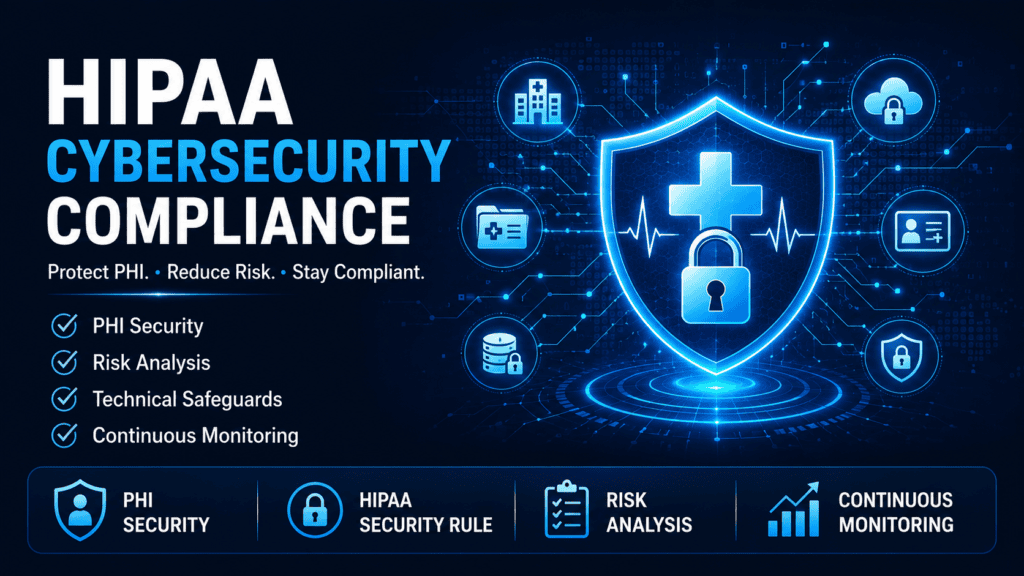
The HIPAA Security Rule is especially important from a cybersecurity standpoint. It applies to electronic protected health information (ePHI) and requires organizations to implement safeguards that protect confidentiality, integrity, and availability.
The Security Rule is built around three categories of safeguards:
Administrative safeguards
These include:
- Risk analysis and risk management
- Security awareness and training
- Workforce access management
- Incident response procedures
- Vendor oversight and contingency planning
Technical safeguards
These include:
- Unique user identification
- Access controls
- Audit controls
- Encryption where appropriate
- Authentication measures
- Transmission security
Physical safeguards
These include:
- Facility access controls
- Workstation security
- Device and media controls
- Secure disposal and reuse practices
For cybersecurity teams, the HIPAA security rule is where compliance and technical controls meet.
HIPAA Breach Notification Rule
The HIPAA Breach Notification Rule mandates covered entities and, in some instances, business associates to disclose a breach of unsecured PHI. Such disclosure consists of the individuals who are affected, the U.S. Department of Health and Human Services, and in some cases the media.
This rule is significant since late detection, weak logging, lack of incident response, and unclear vendor responsibilities can all contribute to making the breach handling more difficult. Apart from being best practices, which are strong security monitoring and incident readiness, are the main support functions for HIPAA compliance.
What Counts as Protected Health Information (PHI)?
PHI is any individually identifiable health information related to a person’s health status, treatment, or payment for care. It can exist in paper records, emails, databases, billing systems, imaging platforms, or cloud applications.
Examples of PHI include:
- Patient names
- Addresses
- Phone numbers
- Email addresses
- Medical record numbers
- Health insurance details
- Appointment and treatment information
- Lab results
- Prescription information
- Billing records linked to a patient
When this type of information is stored in digital format, it is usually called ePHI. This is significant, as ePHI is the primary target of the HIPAA security rule, and it is also the area where many cybersecurity breaches happen.
Some examples are: a spreadsheet of patient billing records left on an unencrypted laptop, a cloud folder, which has been misconfigured and contains intake forms, or an employee who is sending medical records via email without the necessary controls – all these scenarios can raise major issues on HIPAA data protection.
Common HIPAA Compliance Challenges
Most healthcare organizations do not struggle with HIPAA because they are ignoring it entirely. The challenge is usually that day-to-day operations evolve faster than security controls. New systems get added, vendors come on board, employees work remotely, and data starts moving through more channels than leadership realizes.
Here are some of the most common HIPAA compliance and security gaps.
Inadequate access control
The number of employees having access to very sensitive data is too high. Besides making it easier for employees to access data that is not relevant to their job role, the risk of unauthorized data access greatly increases.
Weak passwords and missing MFA
The handful of main reasons for the compromise of healthcare environments are password reuse, shared credentials, and lack of multi-factor authentication.
Limited workforce training
The mere existence of a written policy doesn’t prevent a phishing attack. Besides that, they must be trained practically to recognize suspicious emails, handle PHI securely, follow password hygiene, use devices properly, and report incidents promptly.
Unencrypted devices and email
Cases of lost laptops, wrongly configured mobile devices, and unsecured emailing practices are still sources for unnecessary patient information exposure.
Poor vendor risk management
Business associates and service providers should be watched closely on contracts, security reviews, and access controls because they can create compliance risk without us even noticing.
Missing HIPAA risk assessments
The conducting of a formal HIPAA risk assessment is probably the compliance building block that organizations don’t see the importance of the most. In fact, no assessment means that organizations often fail to discover system vulnerabilities, process deficiencies, and dangerous data flows.
Incident response gaps
We have many organizations performing backups; Still, we are lacking a mature incident response process. A breach situation without clear knowledge of roles, legal responsibilities, containment actions, and communication may cause us to suffer a lot more damage than expected.
HIPAA Security Best Practices for Healthcare Organizations
A strong HIPAA cybersecurity program should reduce both compliance risk and real-world attack exposure. The most effective organizations treat HIPAA as part of a broader security strategy rather than an isolated requirement.
1. Conduct a HIPAA risk assessment regularly
Through a HIPAA risk assessment, you find out where PHI is stored, who is able to access it, how it moves in the environment, and what vulnerabilities might cause its exposure. It’s a comprehensive check that tracks systems workflows vendors, remote access, cloud applications, and backup practices.
Simply putting a spotlight on the issues isn’t a sufficiently thorough risk assessment. Business impact and the probability of a security breach are factored into figuring out the remediation priorities.
2. Apply least-privilege access controls
Not all workers should be given access to the entire corpus. Using role-based access, issuing individual user IDs, deprovisioning timeliness, and conducting regular access audits contribute to minimizing excessive exposure.
3. Require multi-factor authentication
MFA ought to be a baseline for emails VPNs cloud applications, remote access means, administrator IDs, and any system housing or handling ePHI.
4. Encrypt PHI at rest and in transit
Encryption serves as an efficient barrier for laptops, mobile gadgets, cloud storages backups emails, and file transfer mechanisms. Encryption, though the way it is done differs, is still among the top tactics in lowering data exposure.
5. Harden endpoints and servers
Endpoints are frequent entry points for attackers. Healthcare organizations should use:
- Endpoint detection and response tools
- Patch management
- Application control where appropriate
- Secure configuration baselines
- Device inventory and asset visibility
6. Strengthen email security
Email remains one of the highest-risk channels for PHI exposure and phishing compromise. Controls may include:
- Advanced email filtering
- Attachment and link analysis
- Domain protection
- User reporting tools
- Secure messaging or encryption options where needed
7. Build resilient backup and recovery processes
Besides having a solid backup plan, backups must be tested, shielded from altering attempts and consistent with recovery goals. Besides, backup strategies are also critical for ransomware defense and for enabling business continuity when security incidents occur.
8. Train employees continuously
Security training needs to be tailored to work roles, realistic, and continual. Personnel involved in patient scheduling billing care coordination, and clinical workflows face different risks and This way must be trained separately.
9. Monitor logs and investigate anomalies
Audit trails are key to maintaining security of PHI and also to a successful response to incidents. The auditing must include mechanisms to uncover login activity, administrative actions, file access, unauthorized actions, and system changes.
10. Review vendor security before granting access to PHI
Audit trails are key to maintaining security of PHI and also to a successful response to incidents. The auditing must include mechanisms to uncover login activity, administrative actions, file access, unauthorized actions, and system changes.
Consequences of HIPAA Non-Compliance
The cost of poor HIPAA compliance goes well beyond fines. In healthcare, a security failure can disrupt patient care, damage trust, and create long-term business consequences.
Financial penalties
Regulatory penalties may be very heavy, according to the type of violation, how negligent the offender was and whether the organization met the issue and decided to fix the problem.
Reputational damage
Patients feed their trust healthcare providers, and service partners with the protection of their information as a primary concern. A breach would be a sudden loss of the trust that keeps partnerships alive and the business of partnerships looking for more partners.
Operational disruption
Ransomware, hijacked accounts, and tech-forensic investigations can really throw scheduling, clinical workflows, billing, and customer service out of sync.
Legal and contractual exposure
A breach can cause contractual disagreements, invite orders from regulators, expose a case to the courts, and impose on the party various, often complicated, reporting requirements.
Patient trust loss
Trust is the binding factor in the multiple healthcare relationships that are built progressively not only on compliance but also on brand credibility and retention.
How Cyber Guardians Can Help with HIPAA
For healthcare organizations, HIPAA is rarely about one tool or one policy. It usually requires a mix of security assessment, process improvement, technical controls, and staff preparedness. That is where a cybersecurity-focused partner can add value.
Cyber Guardians can support healthcare organizations with practical, compliance-aligned services such as:
- HIPAA risk assessments to identify gaps in safeguards, access controls, vendor exposure, and PHI handling practices
- Vulnerability management to reduce exploitable weaknesses across endpoints, servers, and internet-facing assets
- Security awareness training tailored to phishing, email handling, credential protection, and safe use of patient information
- Incident response planning so your team knows how to contain, investigate, and escalate potential PHI-related events
- Endpoint and email security improvements that reduce common causes of healthcare breaches
- Compliance-focused cybersecurity strategy that supports both operational resilience and HIPAA compliance
The goal is not to turn HIPAA into a paperwork exercise. It is to help organizations build security practices that protect patients, reduce risk, and support long-term trust.
FAQs
1. What is HIPAA in simple terms?
HIPAA is a U.S. law that helps protect sensitive patient health information. It sets rules for how healthcare organizations and certain service providers handle, secure, and disclose protected health information.
2. Who needs to comply with HIPAA?
HIPAA applies to covered entities such as healthcare providers, health plans, and healthcare clearinghouses, as well as business associates that handle PHI on their behalf.
3. What is the HIPAA Security Rule?
The HIPAA Security Rule requires organizations to protect electronic protected health information through administrative, technical, and physical safeguards. This includes access control, risk management, workforce training, and system security measures.
4. What happens if a company violates HIPAA?
A HIPAA violation can lead to regulatory penalties, breach notification obligations, reputational harm, legal exposure, and operational disruption—especially if patient data is exposed or mishandled.
5. How does cybersecurity help with HIPAA compliance?
Cybersecurity supports HIPAA compliance by protecting PHI through controls such as MFA, encryption, endpoint security, email protection, access management, monitoring, incident response, and regular risk assessments.
Conclusion
Healthcare Information Privacy and Security Act (HIPAA) is still one of the most powerful regulations to protect healthcare information. Though, the real advantage of the use of HIPAA in healthcare security practice is the continuous daily decision making. When entities in healthcare view HIPAA as a practical cybersecurity discipline and not only as a regulatory requirement, they become more capable both of protecting PHI and minimizing the risks of breaches, as well as responding to the incidents effectively.
The best way of operating for healthcare professionals, billing companies, digital health firms, and service partners is a proactive one: know where your PHI is located, evaluate the associated risks, limit access, train your employees, secure your vendors, and test your readiness before an incident happens.
Your healthcare company that deals with patient data and desires to have a clear understanding of the current security posture is encouraged to evaluate the compliance with HIPAA, discover areas of improvement, and work on the most impactful enhancements.